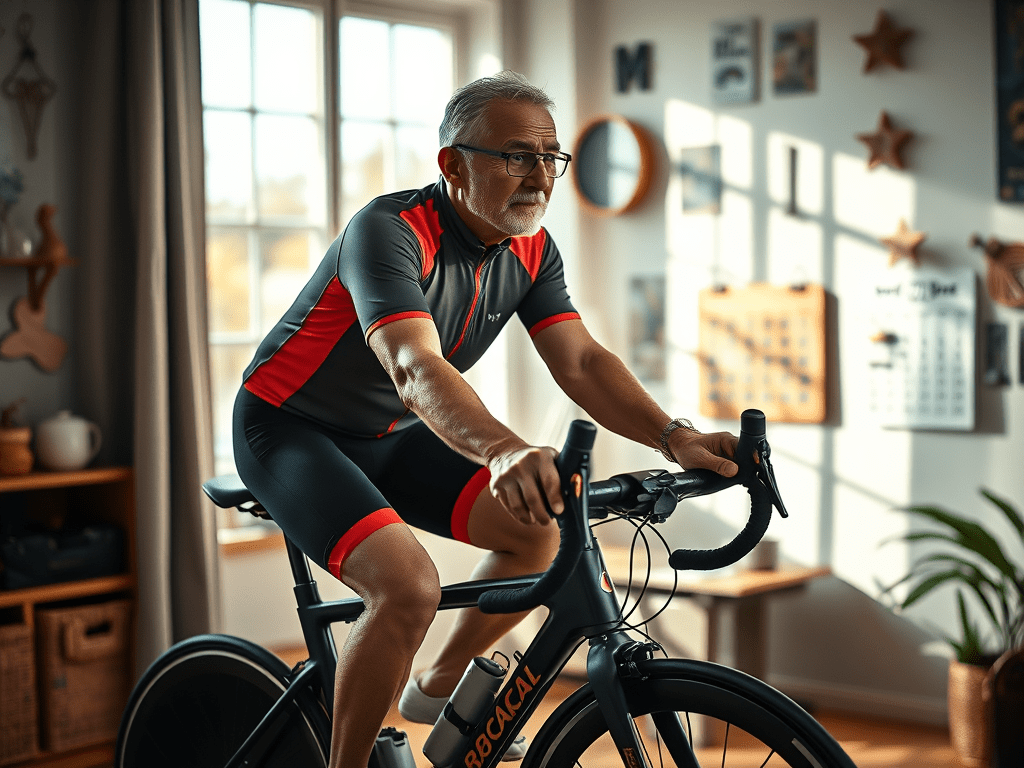
OK, so you already know I used to race bikes and had a debilitating accident last year that introduced me to ROUVY and the “online training world”, so to speak. I was introduced to Zwift right after my accident and went on the platform for approximately 2 weeks. It reminded me of playing Mario Cart, so when I found ROUVY, it was a game changer! All the reservations I had about getting on a trainer disappeared when I discovered ROUVY.

I must admit, a few years ago, I would have been the first person to say that “I will never ride a trainer“. This is in part to my love of the outdoors and my local riding community. I loved getting out and riding with my local riding club. I thought getting on a trainer when the weather is so beautiful outside, is just silly (the weather in South Texas allows for riding outside almost all year long!)
Of course, “the accident” changed all that. I quickly realized that no one can hit you on the trainer! Certainly, the realism of AR really helps. And now, after starting a tempo riding group, it’s even more fun!
So after years of being coached and racing with some of the most talented riders in my state, I have a few tips on how to maintain fitness on the trainer and actually improve your performance.

I’ve always been a firm believer of tempo riding. Lately, there is a lot of talk of training in Zone 2, etc. Well, when I first began training with my coach, he was from the old school of hard days/easy days after building a solid riding base. A lot of Zone 2 riding to get that base, followed by hard interval training.
A lot can be said about a solid riding base, you know, putting in the time and miles or ‘saddle time’. I always thought of this training as “Zone 2“. However, if you stop there, you don’t really get more fit. You’re body learns to ride at that ‘slow-long’ pace. So my coach would add interval training including hard, fast tempo riding and slow, easy recovery days.
So what is Zone 2 training anyway? According to my AI guru:
Zone 2 training refers to a low-intensity exercise level where your heart rate is maintained between 60-70% of your maximum heart rate, essentially a comfortable pace where you can easily hold a conversation while exercising, often considered the foundation for building aerobic capacity and endurance, and is typically used for long-duration workouts like a leisurely jog or moderate bike ride.
And here are some key points about Zone 2 training:
- Intensity: Considered a “base training” level, meaning it’s a low-to-moderate effort that can be sustained for a long time.
- Heart rate range: 60-70% of your maximum heart rate.
- Benefits: Improves aerobic capacity, increases mitochondrial function, promotes fat burning, and can be a great starting point for beginners.
- Example activities: Easy running, leisurely swimming, “moderate” cycling.
So this can also be a little confusing, because “moderate” cycling with a HR range of 60-70% of your maximum heart rate may be more like Zone 3 or Tempo Riding. Tempo riding is not considered Zone 2.

Tempo training is a cycling training method that involves riding at a steady, moderate-to-high intensity for an extended period of time. It’s also known as “zone 3 intensity” or a “threshold” ride.
Tempo training is a good way to build aerobic fitness and endurance, and improve your overall cycling performance. It can help you:
- Build strengthTempo training can help you build strength with relatively little fatigue.
- Utilize other muscle fibersTempo training can help you use muscle fibers that aren’t used during endurance riding.
- Increase VO2 maxTempo training can increase your VO2 max, which measures how efficiently your body uses oxygen.
- Increase lactate thresholdTempo training can help increase your lactate threshold, which is when your body starts to produce lactic acid and your performance declines.
Tempo training is usually done at 76–90% of your Functional Threshold Power (FTP). The intensity should be high enough to make conversation difficult, but not so high that you can’t maintain the pace.
So, how does this play out for the “older cyclist“?

I’m 63 now, and interestingly, I still feel like I did when I was in my 40’s and first started cycling. Well, that’s how I feel, but I think my numbers would disagree. I used to produce a lot more power then than I do now. However, the feeling of intensity and Zone 2 vs Zone 3 is still the same. Unfortunately, for many of us who used to race, our bodies do change with age. We tend to loose 10% of our muscle mass every 10 years ( I think I heard that somewhere?). The good thing is just to continue to ride.
I’ll also let you in on a secret: after turning 60, I bought an e-bike. Now, I was never into strength training or going to the gym, but I swear, riding an e-bike that weights over 30 lbs. with the motor off is like strength training to me!
Well, since getting on the trainer, the e-bike has gotten a little dusty in the garage. I will tell you, when I was training outside, I would alternate days of riding the e-bike and my regular carbon fiber bike as a form of strength training. There was about a 20lb difference in the two bikes and definitely noticeable when the motor was off. ( I only used the motor on really windy, South Texas days against the wind). I did some specific workouts on the e-bike including intervals and tempo rides.
It’s funny, I even took the e-bike out on some Saturday group rides and you had your “hard core” roadies who didn’t really like it. They thought it was ‘cheating’. But, it’s funny how when I took the lead going home into the wind, I never heard a complaint while the ‘complainers’ drafted all the way home!
Of course I could tell them that it’s a bike-assist and the effort is all relative, but most were accepting and enjoyed the pulls.
So, I bring this up, because on the trainer, most of my strength training is now done when I climb. South Texas is pretty flat and windy, so I always did well as an endurance rider and time trialist. On the trainer, it’s a little harder to get that same workout because there is no wind to factor in. This is where the climbs and hilly courses come in.

Over the past few weeks, I’ve been riding some courses with a few hills. I tend to stay in the saddle as long as I can, but often, when I’m in the group ride, I end up out of the saddle during a climb that goes over 2%. Of course, my cadence will significantly drop while my power (watts/kg) will increase, but I try to keep it steady and not go anaerobic.
I recently watched a GCN segment talking about cadence vs strength. The question was “does decreasing your cadence with increased power training increase overall performance and fittness?”
It’s interesting that many “old school” riders used this type of training in their training repertoire. I think the answer is mixed. Most ‘scientific’ reports don’t support the theory. However, I think my improvements in riding have recently been due to climbing and the strength it requires. I try to stay out of the saddle at a comfortable cadence and power without letting the lactate or fatigue set in. It can be tricky, but I base it on my breathing and feel in the legs.
Overall, the things that I miss outside now are being replaced by things that I’m beginning to figure out on the trainer. I just completed a full year on ROUVY and I’m really enjoying every minute of it. The groups and interest in the riding platform is getting better all the time. I remember, when I first started the platform, it was hard to find like riders. Some of the group rides seemed like races and it was difficult to join any ride without going to the app and registering. This took a short time to figure out, but I’m thoroughly convinced the ROUVY platform will be the platform of choice for indoor cycling in the near future.
Let me know what you think and tell me about your journey into ROUVY and this virtual world. I would love to hear your stories and thoughts!
 Al's Ride Club
Leave a comment